SHT31 REPLACEMENT & FHT31 QUALIFICATION
Can FHT31 Replace SHT31? Compatibility and Qualification Guide
NYFEA FHT31 can enter an SHT31 replacement evaluation because the documented package class, I²C addressing, data format and headline accuracy are closely aligned. Approval still depends on the exact SHT31 order code, PCB, firmware, measurement limits and production process.
DIRECT ANSWER
Can FHT31 replace SHT31?
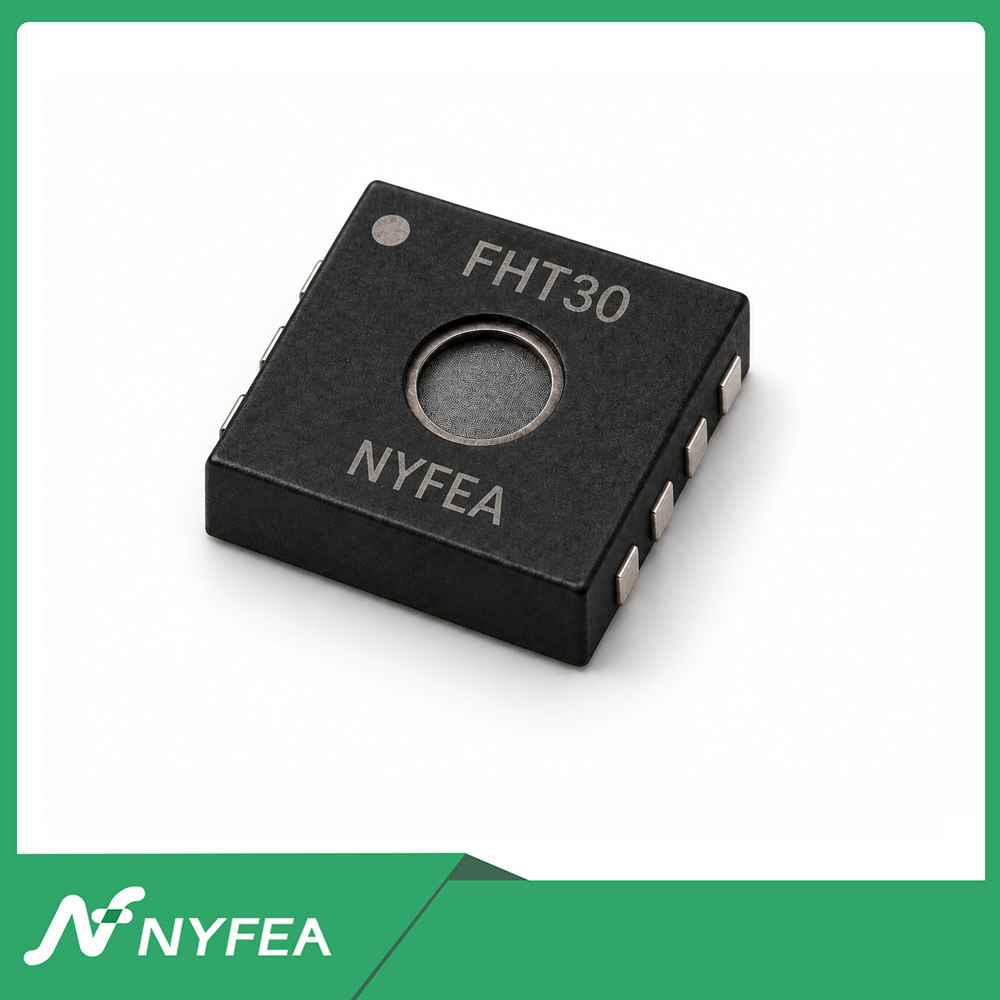
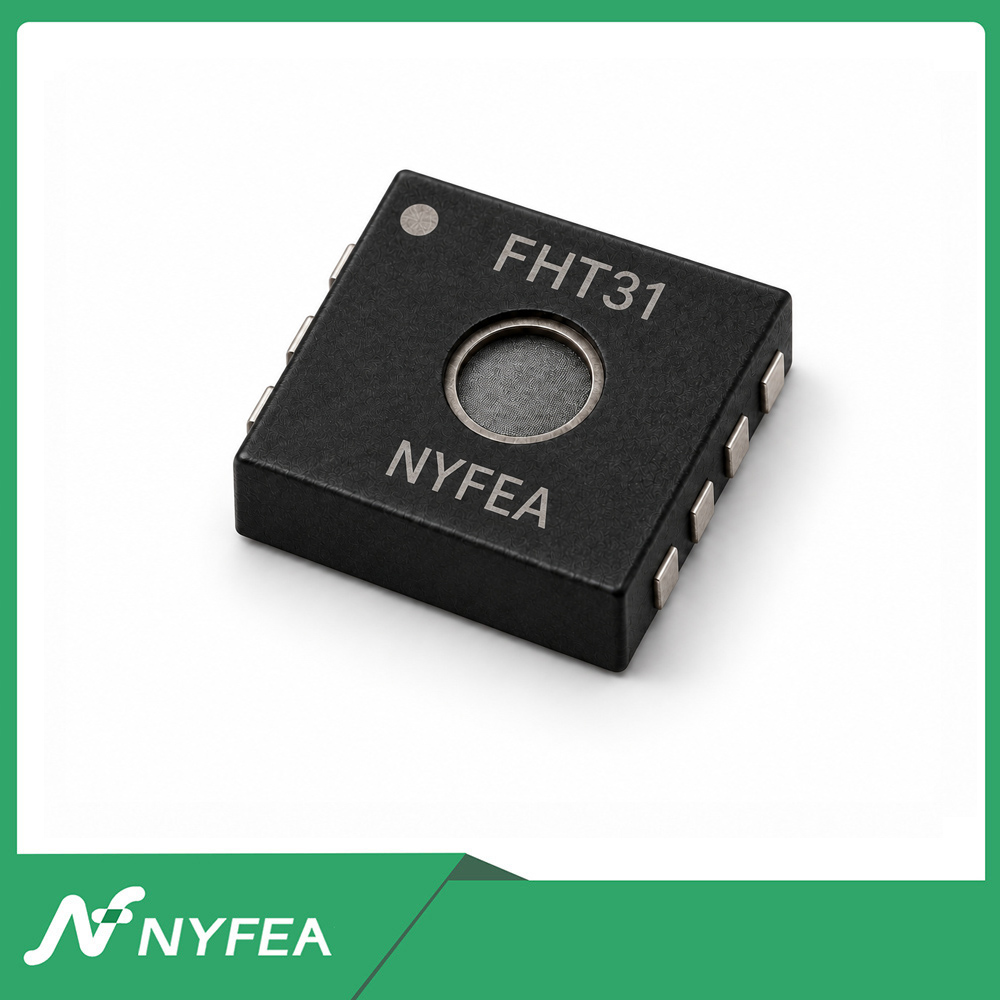
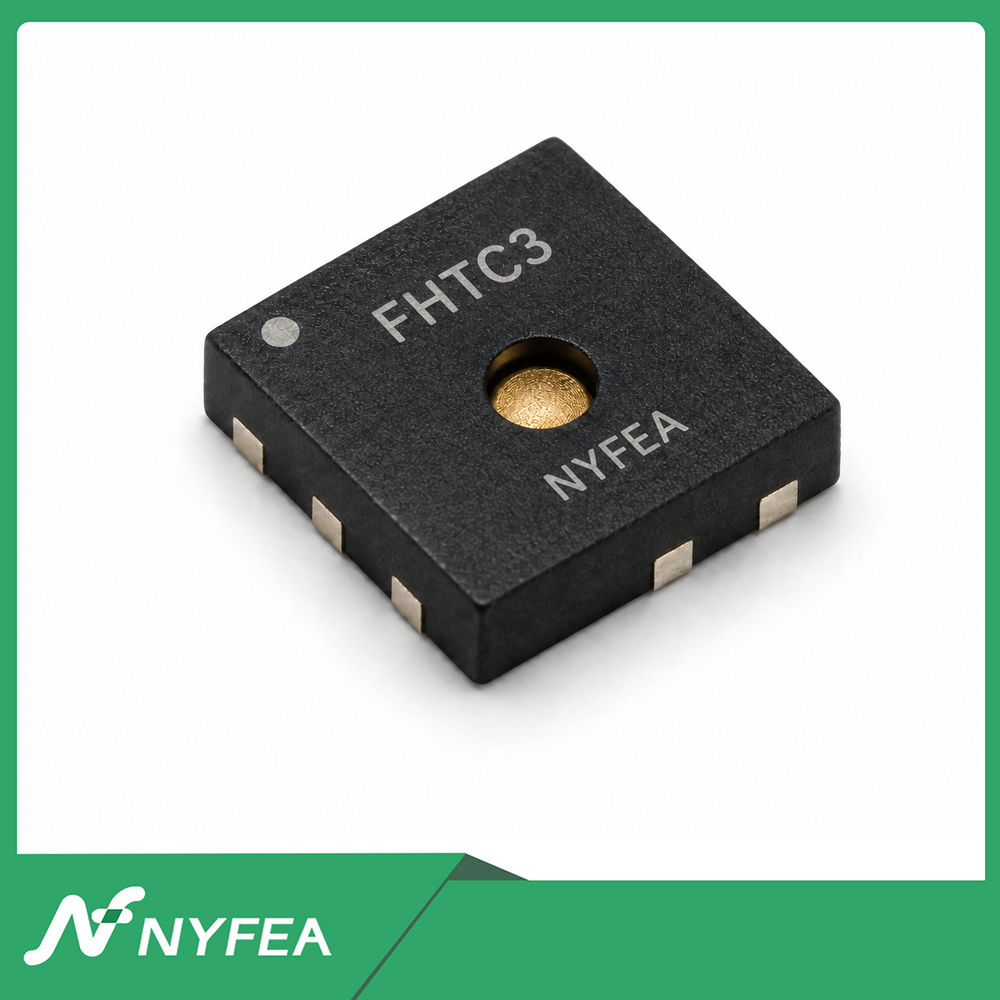
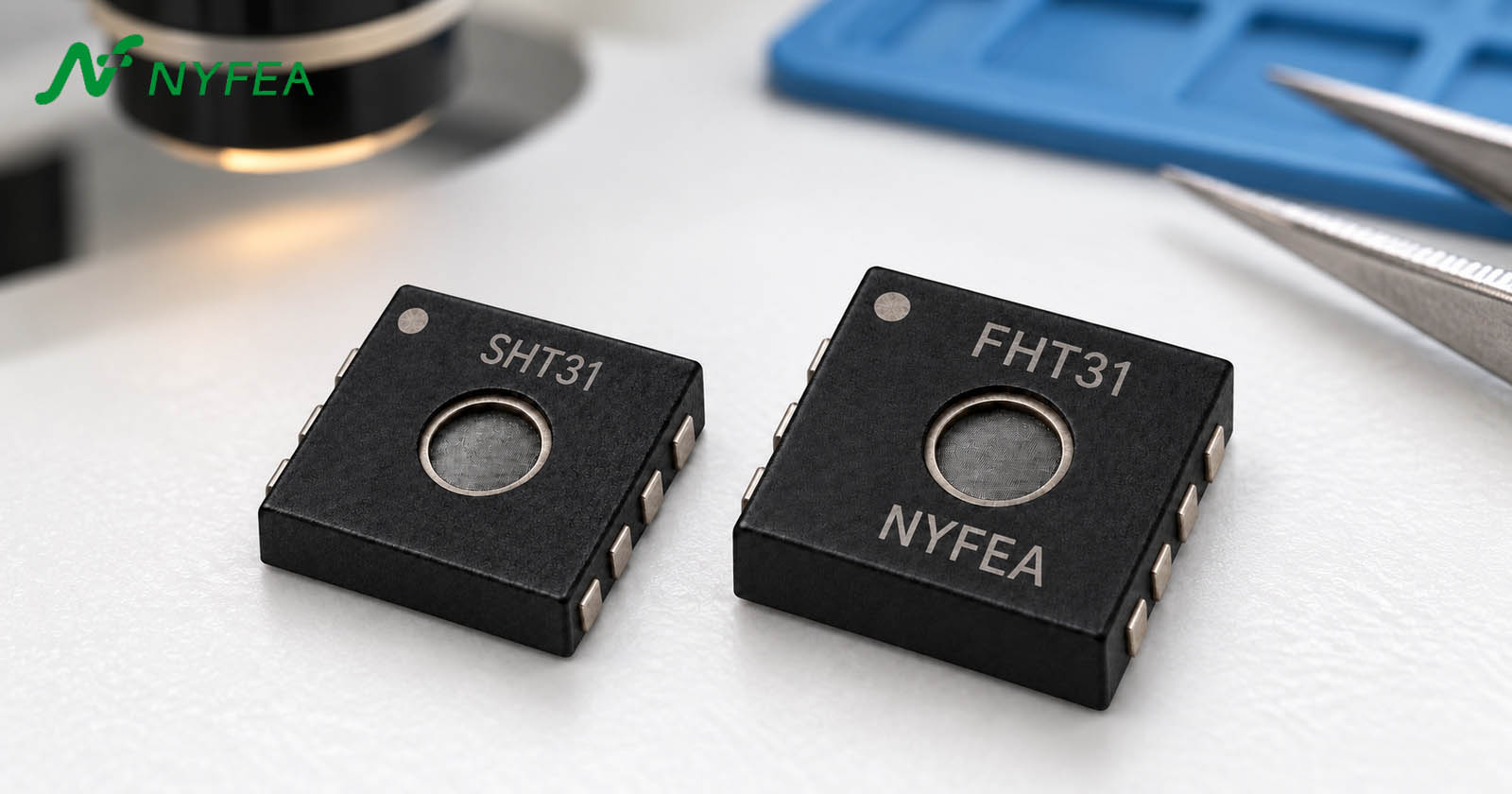
FHT31 is a credible evaluation candidate for an SHT31-based product; it is not automatically approved as a drop-in replacement. Both documents describe a 2.5 mm × 2.5 mm DFN-8 sensor, 0x44/0x45 I²C addresses, operation up to 1 MHz, two CRC-protected 16-bit measurement words, typical ±2%RH and ±0.2 °C headline accuracy, ALERT, nRESET and a heater.
Start the evaluation if those functions match the product need. Approve the change only after the exact package height and land pattern, every firmware command and timeout, assembled-product error budget, and manufacturing process have passed their acceptance limits.
What must be true before FHT31 is approved?
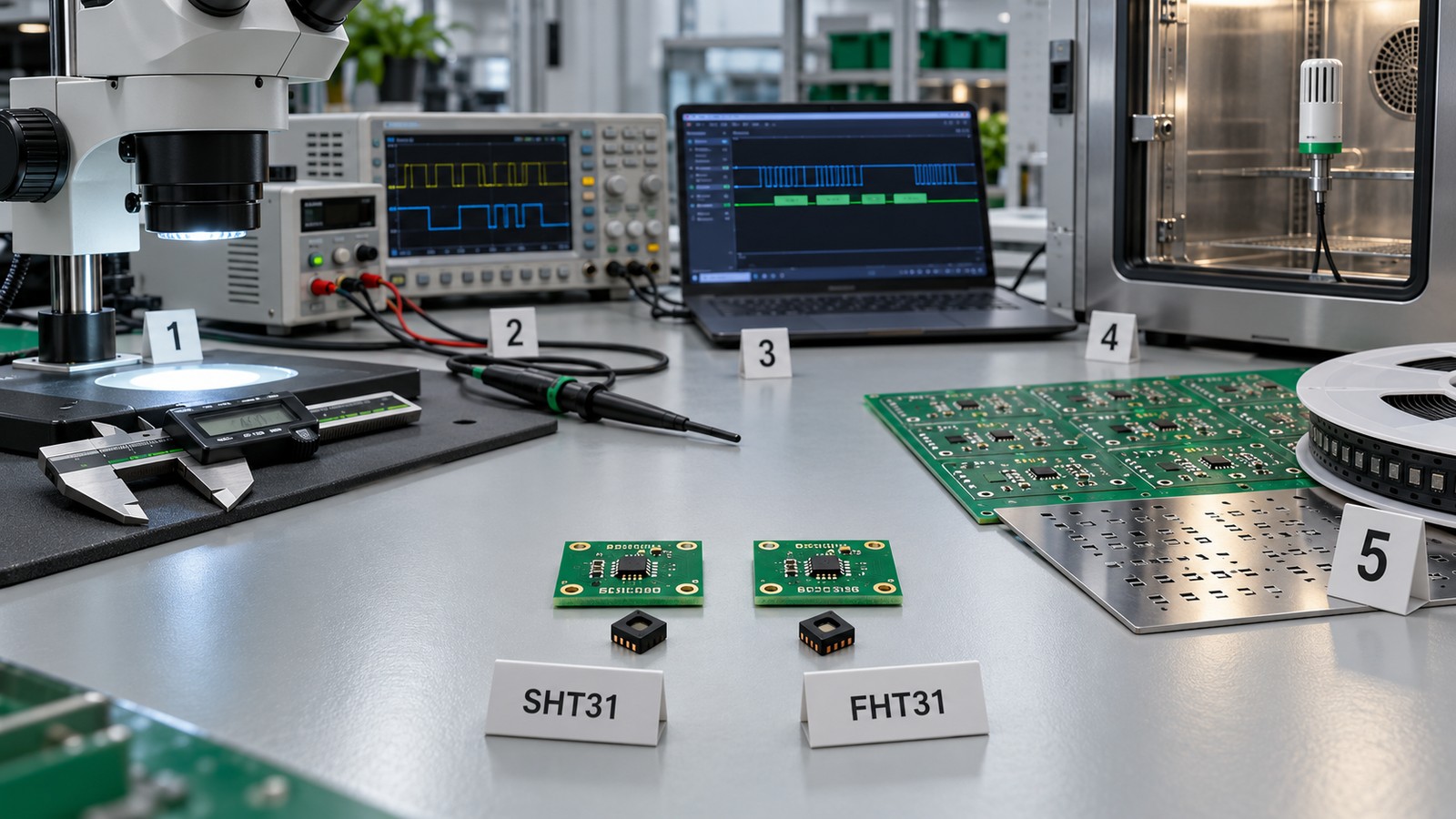
| Gate | Approval question | Evidence to retain |
|---|---|---|
| PCB and assembly | Does the exact FHT31 drawing fit the land pattern, stencil, z-height, cavity clearance and pick-and-place process? | Drawing overlay, assembly inspection and process record |
| Firmware | Does FHT31 pass every command, state, wait time, CRC, status, reset and recovery path used in production? | Driver audit, raw frames, error log and logic capture |
| Measurement | Does the installed FHT31 assembly meet the product's temperature, RH, response and recovery limits? | Paired comparison against a reference with known uncertainty |
| Production | Do reflow, cleaning, materials, enclosure assembly and lot variation remain inside the acceptance plan? | Pilot-build, environmental and lot-level results |
If any gate is open, record FHT31 as under evaluation and name the remaining test. This keeps engineering, purchasing and quality teams aligned on the actual decision status.
Review scope checked October 5, 2026
- SHT31 values are taken from Sensirion's SHT3x-DIS datasheet, revision December 2022, and its current product catalog.
- FHT31 values are taken from the current NYFEA FHT31 product specification summarized on the product page.
- This page compares documented component characteristics. It does not report an NYFEA A/B qualification test or approve a finished product.
What matches between SHT31 and FHT31, and what still needs validation?
Use this matrix to decide what can be reused and what must be requalified. The figures are screening inputs; the replacement decision comes from the evidence in the last column.
| Item | Sensirion SHT31-DIS-B | NYFEA FHT31 | Replacement implication |
|---|---|---|---|
| I²C address | 0x44 or 0x45 | 0x44 or 0x45 | Documented alignment; address ACK alone is insufficient. |
| Electrical and bus limits | 2.15 V to 5.5 V; up to 1 MHz | 2.0 V to 5.5 V; up to 1 MHz | Check power-on behavior, logic rail, pull-ups, capacitance, rise time and clock stretching on the actual bus. |
| Protocol frame | 16-bit temperature + CRC; 16-bit RH + CRC | 16-bit temperature + CRC; 16-bit RH + CRC | Run the deployed commands, verify six returned bytes and both CRC values, then test timeout and recovery paths. |
| Typical RH accuracy | ±2%RH | ±2%RH | Compare accuracy curves, conditions and finished-product error budget; typical figures are not universal limits. |
| Typical temperature accuracy | ±0.2 °C | ±0.2 °C from −40 °C to +90 °C | Use the curves and application range, then test the installed assembly. |
| Control functions | ALERT, nRESET, status register and heater | ALERT, nRESET, status register and heater | Verify only the functions used by the product, including thresholds, reset timing and heater recovery. |
| Package outline | 2.5 mm × 2.5 mm DFN-8; nominal height about 0.9 mm | 2.5 mm × 2.5 mm DFN-8; specified height 1.14 mm to 1.26 mm | Mechanical review required: compare drawings, land pattern, stencil, cavity clearance and enclosure height. |
| Ordering and protection | Multiple SHT31 order and membrane/protection options exist | FHT31-TR is documented with a dustproof breathable film | Compare exact order codes rather than family names. |
Interpretation: “Documented alignment” means the published values support a closer evaluation. It does not mean NYFEA has validated every SHT31 order code, host driver, PCB, enclosure or production process.
Five layers determine whether FHT31 can replace SHT31
A useful compatibility statement names the layer that has actually been proven. “Same function,” “same pins,” “same firmware behavior,” and “validated in production” are different conclusions.
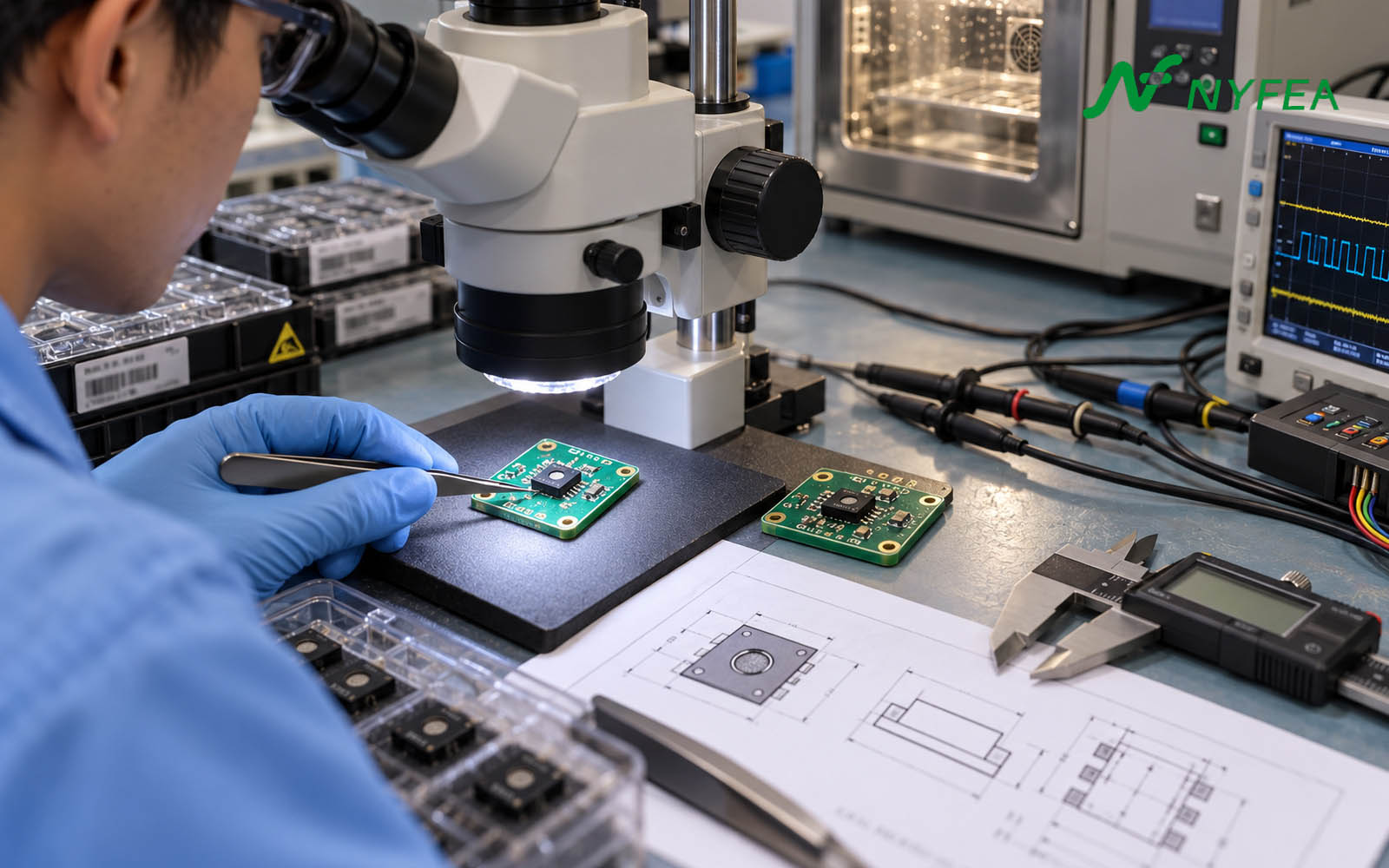
1. Mechanical compatibility
Compare the package drawing, maximum height, pin-one orientation, exposed-pad treatment, recommended land pattern, stencil opening, sensing-cavity clearance and tape orientation. A shared 2.5 mm × 2.5 mm outline does not prove the same z-height or assembly window.
2. Electrical compatibility
Compare every pin function, supply range, power-on reset behavior, input thresholds, output sink capability, idle and measurement current, bypassing, ADDR strapping, pull-ups and unused-pin treatment. Confirm that other devices on the bus tolerate the selected pull-up rail.
3. Protocol and firmware compatibility
Inventory every command the deployed firmware sends: measurement modes, periodic fetch, status, reset, heater, alert thresholds, serial identification and error recovery. Compare command codes, allowed device state, maximum wait time, clock-stretch behavior, response length and CRC handling.
4. Measurement compatibility
Compare accuracy curves, repeatability, hysteresis, response time, long-term drift, high-humidity recovery and temperature range under matched conditions. Then repeat the comparison on the final PCB because heat conduction and enclosure airflow can dominate the component difference.
5. Production compatibility
Verify reflow, cleaning, coating masks, adhesives, storage, contamination control, traceability and lot acceptance. Production release requires evidence from the actual assembly route, not only hand-soldered evaluation boards.
Why a response at I²C address 0x44 does not prove compatibility
An I²C scanner usually proves only that a device acknowledged one address phase. It does not prove that the sensor accepts the product's measurement command, completes conversion before the timeout, returns six correct bytes, passes two CRC checks, supports the required status or reset path, or reports ambient conditions within the system error budget.
Use the first divergent transaction as the diagnostic anchor. Record the command, device state, ACK or NACK, conversion wait, returned byte count, raw bytes, both CRC results, bus clock, supply and recovery action. That record separates an electrical problem from a command mismatch or a measurement-placement problem.
Practical rule: address ACK means discovery; a command with valid CRC means protocol progress; only the assembled-product test answers the accuracy question.
Use this 12-step SHT31-to-FHT31 qualification workflow
The workflow below creates retained evidence for engineering, purchasing and production. A failed step does not automatically reject FHT31; it shows whether the project needs firmware work, PCB changes, process controls or a different candidate.
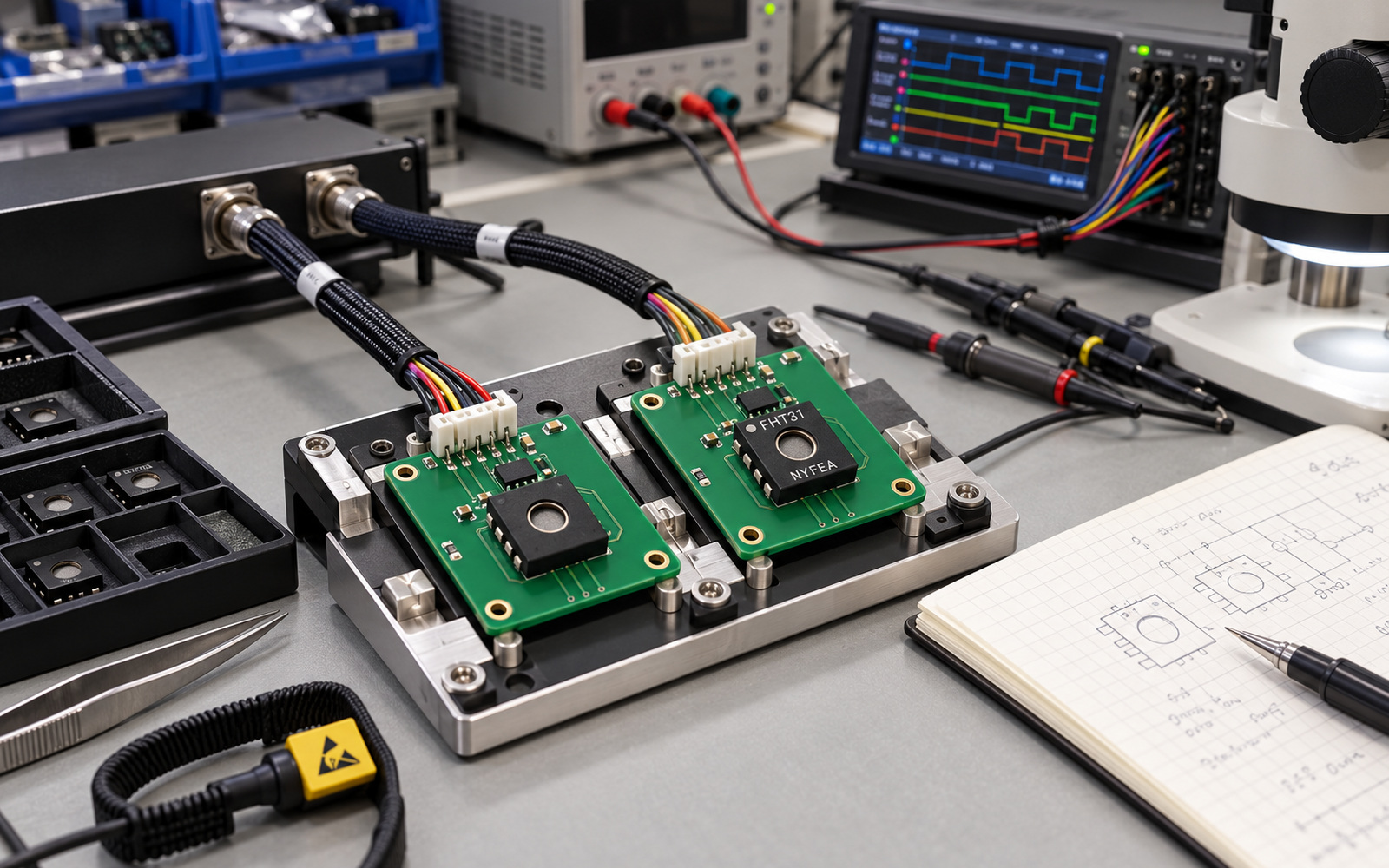
Phase 1Define the comparison baseline
- Freeze the SHT31 baseline. Record the exact order code, schematic, PCB, firmware, enclosure and acceptance limits.
- Collect controlled specifications. Use current SHT31 and FHT31 documents, not marketplace listings or family-level summaries.
- Check mechanical fit. Compare outline, height, pads, pin one, sensing cavity, stencil and keep-out requirements.
Phase 2Prove electrical and firmware compatibility
- Audit every pin and net. Verify SDA, SCL, ADDR, ALERT, VDD, VSS, nRESET and unused contacts.
- Measure electrical margins. Check the power ramp, current, pull-ups, bus capacitance, rise time and reset behavior.
- Map the deployed commands. Verify command codes, device states, wait times, response length, CRC and recovery.
Phase 3Test matched assemblies
- Expose failure paths. Log the first NACK, timeout, short read, CRC fault or invalid value instead of only “sensor not found.”
- Build paired prototypes. Test traceable SHT31 and FHT31 boards with the same host, bus and enclosure.
- Compare measurements. Use one independent reference, stable windows, controlled steps and position swaps.
Phase 4Confirm production readiness
- Repeat process and environment tests. Cover reflow, cleaning, materials, high humidity, recovery and operating temperature.
- Review sample and lot evidence. Retain distributions and failure counts based on product risk and error budget.
- Make a release decision. Record FHT31 as qualified, approved with changes, under evaluation or rejected—with the reason.
How should SHT31 and FHT31 measurements be compared?
SHT31 and FHT31 should be compared as installed assemblies in the same representative airflow, with an independent reference whose uncertainty is known. Log temperature and RH together because local heating can raise sensor temperature and lower reported relative humidity even when the moisture content of the air has not changed.

Minimum data to retain
- Device and lot identity, PCB position, firmware build and timestamp.
- Raw temperature and RH words, CRC status, converted values and error flags.
- Reference value and uncertainty, airflow condition and enclosure state.
- Nearby heat-source state, supply voltage, sample interval and equilibration time.
- Stable-window bias, repeatability, step response, recovery and rejected samples.
If the difference follows physical position, investigate airflow and thermal coupling. If it follows the device across position swaps, investigate calibration, contamination, protocol, lot and component behavior. Do not infer accuracy from a single room reading or a warm-air demonstration.
Should the project replace, migrate or redesign?
| Evidence outcome | Recommended project decision | Permitted wording |
|---|---|---|
| Mechanical, electrical, firmware, measurement and process gates all pass under documented conditions | Approve FHT31 for the named product, revision and manufacturing scope | “Project-qualified replacement under the stated conditions” |
| Package and electrical fit pass, but firmware behavior differs | Plan a controlled firmware migration and repeat regression tests | “Candidate requiring firmware changes” |
| Pin, land pattern, height or PCB constraints differ | Redesign the PCB or evaluate another candidate | “Functional alternative requiring hardware changes” |
| Measurement or production evidence is incomplete | Keep the candidate under evaluation; do not release to production | “Candidate for evaluation” |
NYFEA FHT31 is positioned at the fourth level until project evidence is supplied: candidate for evaluation in SHT31-based designs. A customer-specific qualification record can support a stronger conclusion for that exact product, but it should not be generalized to every SHT31 design.
SHT31 replacement FAQ
Is FHT31 pin-compatible with SHT31?
The documented pin names and functions align at the family-comparison level, but pin compatibility must include the exact package drawing, land pattern, height, exposed pad, reserved pin treatment and assembly process. Confirm the exact SHT31 order code and current controlled drawings before using the term “pin-compatible.”
Does FHT31 use the same I²C address as SHT31?
Both devices document 7-bit addresses 0x44 and 0x45, selected by the ADDR state. This supports an interface evaluation but does not prove that every command, timing rule or error path is interchangeable.
Can the existing SHT31 driver be reused with FHT31?
It may be reusable if every command and timing path used by the driver is verified. Audit measurement modes, periodic fetch, clock stretching, CRC, status, reset, heater, alert thresholds, identification, timeouts and bus recovery, then run regression tests on the target controller.
Do matching ±2%RH and ±0.2 °C figures prove equal accuracy?
No. Those are typical headline figures. Compare the accuracy curves, temperature and humidity conditions, maximum limits, response, hysteresis, drift and final-assembly error budget. Test both installed assemblies against the same reference.
Why is package height important if both devices are 2.5 mm × 2.5 mm?
Package height can affect enclosure clearance, gasket compression, airflow, pick-and-place setup and inspection criteria. The current documents list different height values, so a top-outline match alone is not a complete mechanical check.
What is the fastest useful screening test?
Start with a controlled document comparison and a paired target-board test. Verify power-up, the deployed command sequence, exact six-byte reads, both CRC values and stable temperature/RH measurements in the same airflow. This identifies major mechanical, electrical, protocol and placement problems before a larger qualification run.
When can FHT31 be called a drop-in replacement?
Only when retained evidence shows that the exact product can use FHT31 without unintended PCB, firmware, function, performance, environmental or production changes under clearly stated conditions. The current public comparison supports evaluation, not a universal drop-in claim.
Primary technical sources
- Sensirion, Datasheet SHT3x-DIS, revision December 2022. Source for SHT31 electrical, interface, measurement and package information.
- Sensirion SHT31-DIS-B product catalog. Used to confirm the current product identity and download source.
- NYFEA FHT31 product page. Source for FHT31 electrical, interface, measurement, command and package information.
Evidence boundary: this article compares published specifications. No unpublished A/B test, field history, certification or customer production approval is claimed.
Trademark notice: Sensirion and SHT31 are identifiers or trademarks of their respective owners. NYFEA and FHT31 are independent and are not affiliated with, endorsed by, or sponsored by those owners. References are provided for engineering identification and comparison.
NEXT STEP
Evaluate FHT31 in your SHT31-based design
For a useful review, provide the exact SHT31 order code, schematic and PCB revision, supply voltage, I²C speed and command list, accuracy budget, enclosure, environmental range, production process and expected quantity.