
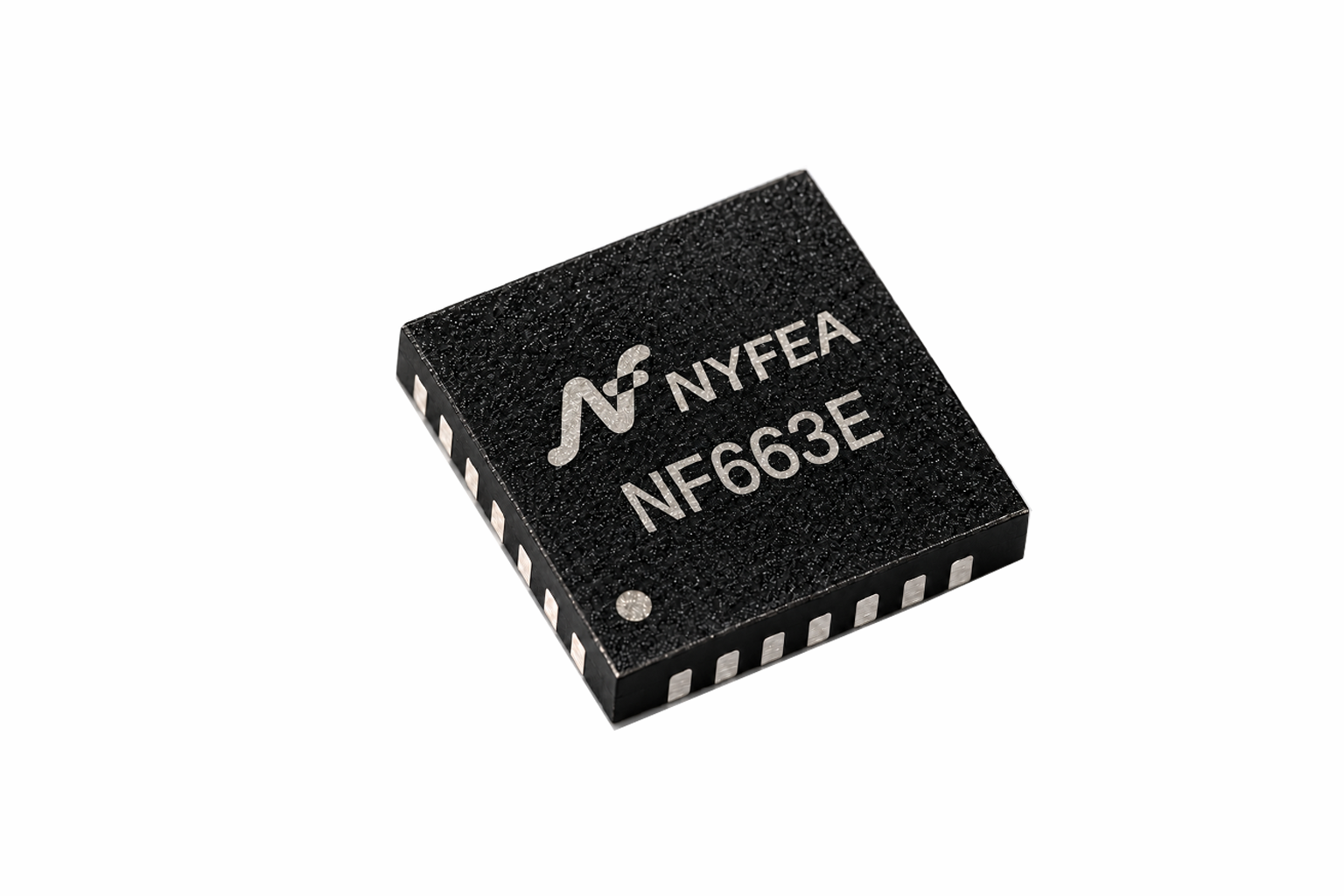
Product Overview and Selection Scope
NF663E combines a high-output 13.56 MHz RF frontend with protocol framing, parity and CRC handling, a 512-byte FIFO, 8 KB EEPROM, programmable I/O, timers and interrupt resources. It is intended for host-controlled multi-protocol readers that support several HF card and tag families on one platform.
The specification states a typical distance up to 12 cm for a suitable ISO/IEC 14443 Type A or MIFARE setup. This is not a guaranteed IC-only specification.
Multi-Protocol Air-Interface Coverage
Host Interfaces and Integrated Resources
| Function | Documented capability | Engineering use |
|---|---|---|
| SPI | Up to 10 Mbit/s | Deterministic, high-throughput MCU connection. |
| I²C | 400 kBd Fast mode; 1000 kBd Fast-mode Plus | Two-wire host integration where supported by the MCU. |
| UART | Up to 1228.8 kBd | Asynchronous serial host connection. |
| SAM interface | Separate I²C interface | Secure access module connection independent of the host bus. |
| Buffer / memory | 512-byte FIFO / 8 KB EEPROM | Frame buffering and nonvolatile configuration. |
| Programmable I/O | Up to 8 pins | Board control and system integration. |
Verified Electrical and Power Data
| Parameter | Documented value | Engineering note |
|---|---|---|
| Supply voltage | 3.0 V to 5.5 V | Observe all documented pin-domain and sequencing requirements. |
| Supply current | 17 mA typical; 20 mA maximum | Specified IC condition; RF-driver loading is application-dependent. |
| Hard power-down | 8 nA typical; 40 nA maximum | PCB leakage and other system loads are additional. |
| Standby | 3 µA typical; 6 µA maximum | IC-only standby condition. |
| LPCD sleep | 3 µA typical; 6 µA maximum | Sleep phase under the documented LPCD conditions. |
| Ambient temperature | −25 °C to +85 °C | Operating ambient range in the quick-reference data. |
Host MCU, regulators, level shifting, LEDs, secure elements and RF-network losses are not included in the IC-only low-power figures.
Typical Application Circuit
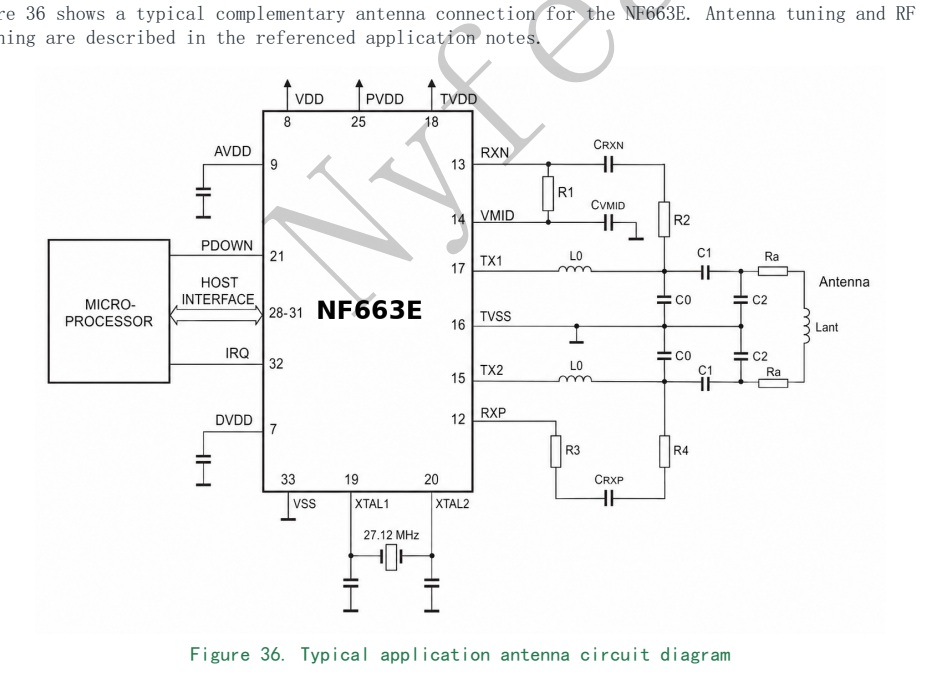
The reference circuit defines the functional topology for supplies, host interface, crystal, balanced transmitter, receiver and antenna network. RF component values are antenna-specific and must be tuned on the production PCB.
HVQFN32 Package and Pinout
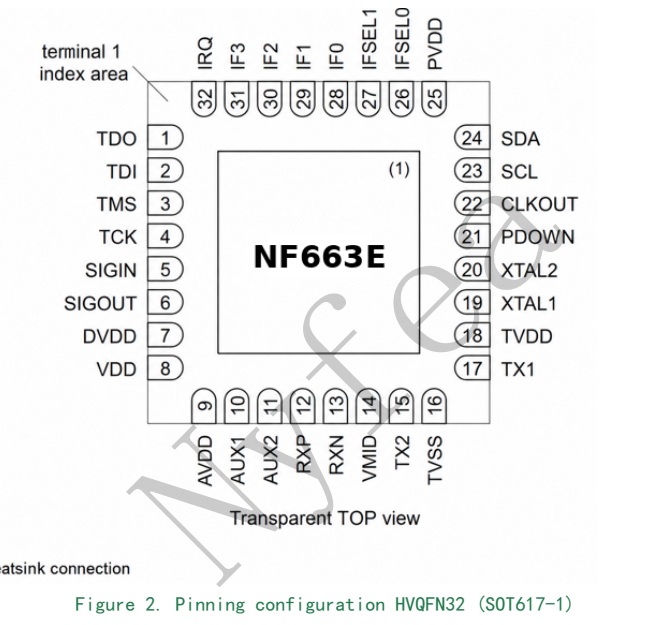
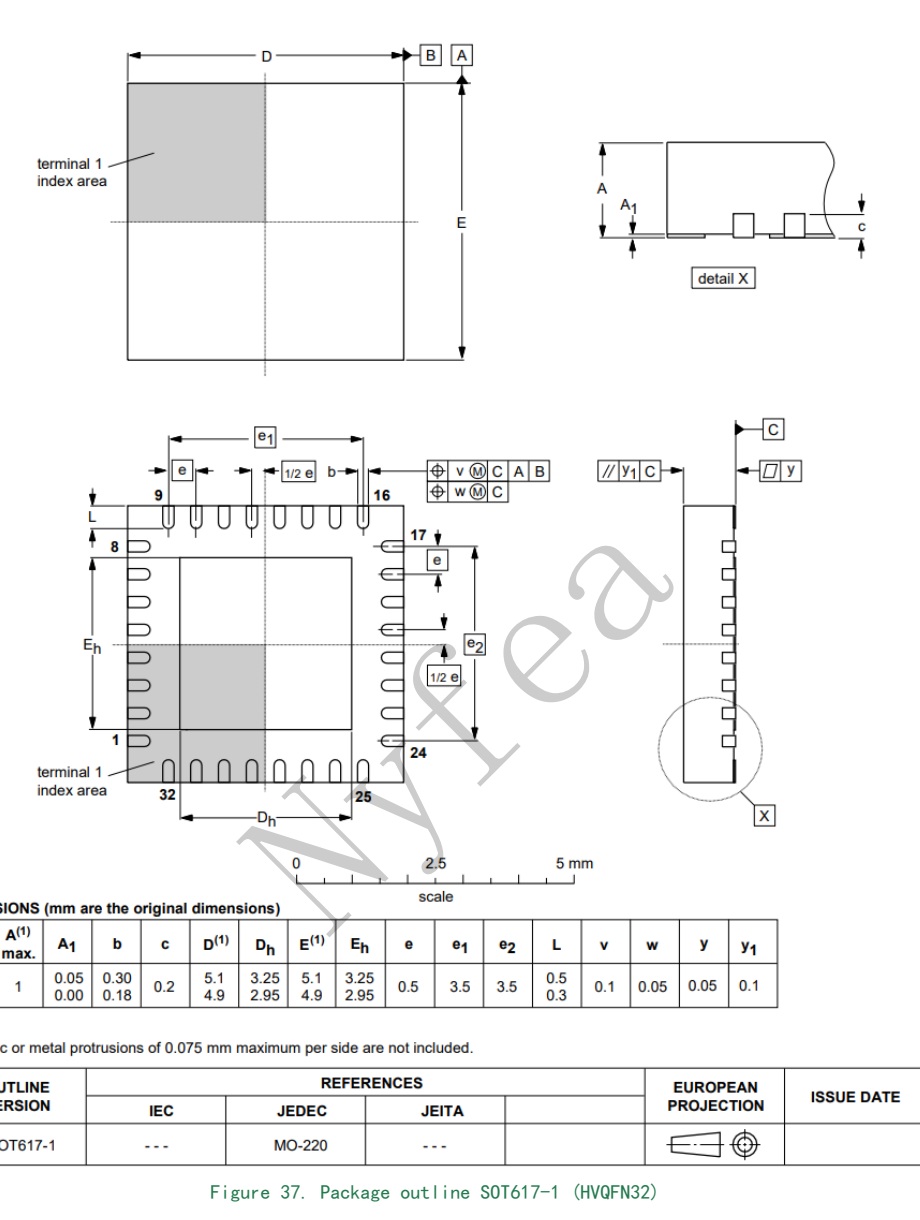
NF663E is specified in the 32-terminal HVQFN package SOT617-1 with a 5 mm × 5 mm body and 0.85 mm maximum height. The document lists moisture sensitivity level MSL2 and a 260 °C peak reflow classification.
Application Areas
 Industrial HF RFIDReader and identification equipment.
 Embedded readersCompact reader terminals.
 Transit and ticketingContactless validation systems.
 Connected accessNetworked authorization systems.
 NFC devicesMulti-standard contactless products.
Engineering Guidance
Engineering FAQs
Can NF663E achieve a 12 cm read range in every design?
No. The specification gives a typical result under suitable conditions. Actual range depends on antenna, matching, supply, card or tag, orientation, enclosure, noise and firmware.
Can NF663E directly replace another 13.56 MHz reader IC?
Do not assume drop-in compatibility. Compare the pinout, exposed pad, supplies, host-interface selection, register map, EEPROM, firmware, RF network and package.
Does protocol support mean a finished reader is certified?
No. IC capability does not certify the final terminal. Complete the regulatory, interoperability and industry approvals required for the intended market.
This page summarizes the supplied NF663E product specification for component evaluation. Confirm the latest controlled revision, RF design, test conditions, assembly process and qualification requirements before production release.