RFID Reader IC
MFRC522-Compatible Replacement: NYFEA NF522 13.56 MHz RFID Reader IC
A concise technical guide to MFRC522, RC522 modules and NF522 as a compatible alternative—including protocols, interfaces, low-power operation and migration considerations.
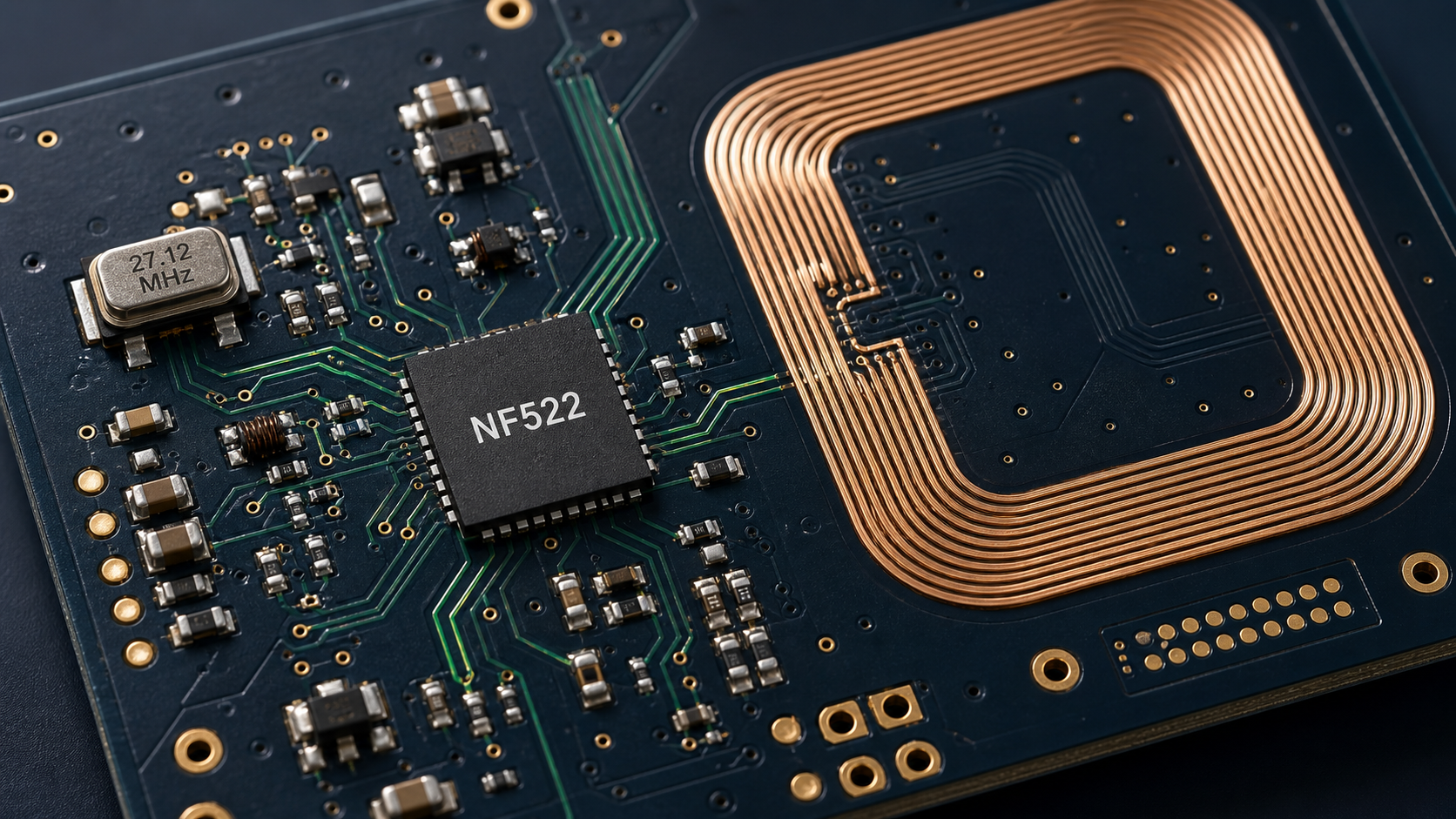
MFRC522 is widely used in smart locks, access-control systems, identification terminals and embedded card readers. For manufacturers maintaining an MFRC522 design—or developing a new 13.56 MHz reader—NYFEA NF522 offers an MFRC522-compatible migration option with broader protocol coverage and integrated low-power card detection.
NF522 is a 13.56 MHz contactless reader/writer IC developed by NYFEA as a compatible alternative for common MFRC522 applications. It supports ISO/IEC 14443 Type A/B and ISO/IEC 15693, provides SPI, I²C and UART host interfaces, and includes low-power card detection.
Key takeaways
- MFRC522 is a reader IC; RC522 usually refers to a module built around that IC.
- NF522 retains the familiar 13.56 MHz reader architecture while adding Type B, ISO/IEC 15693 and LPCD.
- Existing PCB, antenna and firmware designs can provide a practical starting point, followed by final system-level validation.
- NF522 is intended for smart locks, access control, identification and other embedded reader products.
What is the MFRC522?
MFRC522 is a highly integrated 13.56 MHz contactless reader/writer IC from NXP. It is designed primarily for ISO/IEC 14443 Type A communication with MIFARE and NTAG products and provides SPI, I²C and UART host interfaces.
The IC integrates RF transmission and reception, digital processing, CRC generation and checking, and a 64-byte FIFO. It is commonly used to read and write compatible 13.56 MHz contactless cards and tags.
MFRC522 is an RFID reader front end rather than a complete NFC controller. It does not, by itself, provide the full card-emulation and peer-to-peer feature set associated with a complete NFC controller.
MFRC522 vs. RC522: What is the difference?
The terms are frequently used interchangeably online, but they usually describe different product levels:
- MFRC522 normally refers to the reader IC itself.
- RC522 or RFID-RC522 normally refers to a complete module built around the MFRC522, with a PCB antenna and supporting components.
A user searching for “MFRC522” may be looking for an IC, data sheet or replacement part. A user searching for “RC522 module” is more likely to be looking for a ready-made antenna module, wiring information or development code.
NF522 vs. MFRC522 comparison
| Feature | MFRC522 | NYFEA NF522 |
|---|---|---|
| Operating frequency | 13.56 MHz | 13.56 MHz |
| ISO/IEC 14443 Type A | Supported | Supported |
| ISO/IEC 14443 Type B | Not supported | Supported |
| ISO/IEC 15693 | Not supported | Supported |
| Maximum Type A data rate | 848 kbit/s | 848 kbit/s |
| Host interfaces | SPI, I²C, UART | SPI, I²C, UART |
| Maximum SPI rate | 10 Mbit/s | 12 Mbit/s |
| FIFO | 64 bytes | 64 bytes |
| External crystal | 27.12 MHz | 27.12 MHz |
| Package | HVQFN32 | QFN32 |
| Low-power modes | Power-down modes | HPD, SPD and LPCD |
| Typical LPCD current | — | 9.27 µA under stated conditions |
| Reader distance | Typically up to 50 mm* | Up to 100 mm* |
| Operating temperature | −25°C to +85°C | −25°C to +85°C |
* Read distance depends on the card or tag, antenna geometry, impedance matching, supply conditions, PCB layout and product enclosure. Values from separate data sheets are not same-condition benchmark results; validate final performance in the complete product.
NF522 technical highlights
Multi-protocol reader operation
NF522 supports ISO/IEC 14443 Type A, Type B and ISO/IEC 15693. Type A and Type B operation supports 106, 212, 424 and 848 kbit/s. ISO/IEC 15693 supports single- and dual-subcarrier modes, with maximum rates of 52.97 kbit/s and 26.69 kbit/s respectively.
This broader protocol set allows manufacturers to reuse one reader platform across a wider range of cards, tags and product variants.
Low-power card detection
NF522 provides Hard Power-Down (HPD), Soft Power-Down (SPD) and Low-Power Card Detection (LPCD). In LPCD mode, the IC periodically checks for a card and can wake the host system through an interrupt.
The NF522 data sheet specifies a typical LPCD current of 9.27 µA with AVDD and TVDD at 3.3 V and an external clock. Total product power also depends on the MCU, power circuitry, antenna configuration and detection interval.
Flexible host interfaces
NF522 supports SPI, I²C and UART. SPI operates at up to 12 Mbit/s and supports modes 0 and 3; I²C operates at up to 400 kbit/s; and UART operates at up to 1.2288 Mbit/s.
RF and electrical design
With a suitable antenna, tag and matching network, NF522 reader distance can reach up to 100 mm. The reference circuit recommends tuning the antenna impedance to 40–50 Ω. Final RF tuning should account for antenna inductance, Q factor, enclosure materials and nearby metal.
NF522 has separate digital, analog, I/O and RF-transmitter power domains. TVDD and PVDD operate from 2.0 to 5.0 V; AVDD and DVDD operate from 2.3 to 5.0 V. The technical data also specifies HBM 8 kV and CDM 500 V ESD capability.
Migrating from MFRC522 to NF522
For a standard MFRC522 reader design, the existing PCB, antenna and firmware architecture can be used as the starting point for NF522 migration. The exact amount of modification depends on the pins, registers, firmware functions and card types used in the original product.
- Confirm the QFN32 footprint, PCB pads and any special auxiliary-pin usage.
- Review the power, reset, 27.12 MHz crystal and host-interface configuration.
- Validate initialization, authentication, read/write commands and interrupt handling.
- Retune the antenna as needed and verify stable read range in the final enclosure.
- Test low-power detection, wake-up behavior and total system current.
Typical applications
- Smart locks, access control and attendance terminals
- Identification terminals and portable card readers
- Digital keys, charging equipment and consumables authentication
- Campus, transport and other contactless card systems
- Battery-powered readers requiring low-power card detection
- ISO/IEC 14443 Type B and ISO/IEC 15693 reader products
Protocol, security, regulatory and industry-specific requirements should be verified at the complete-system level.
NYFEA engineering and supply support
For international OEMs and equipment manufacturers, NYFEA offers cost-competitive project pricing, application engineering and supply support from prototype through volume production. Engineering support may cover schematic review, firmware migration, host-interface debugging, antenna-matching guidance and LPCD configuration.
Frequently asked questions
What is the MFRC522?
MFRC522 is a 13.56 MHz contactless reader/writer IC from NXP. It is designed primarily for ISO/IEC 14443 Type A communication with MIFARE and NTAG products and provides SPI, I²C and UART host interfaces.
Is RC522 the same as MFRC522?
Not exactly. MFRC522 normally refers to the IC. RC522 or RFID-RC522 normally refers to a reader module built around that IC and equipped with a PCB antenna and supporting components.
What IC can replace MFRC522?
NYFEA NF522 is designed as a compatible alternative for common MFRC522 reader applications. It also adds ISO/IEC 14443 Type B, ISO/IEC 15693 and low-power card detection. The target PCB, firmware, antenna and tag set should be validated before production.
Can an existing MFRC522 antenna be used with NF522?
The existing antenna and matching network can be used as a migration starting point. Final impedance matching and read-range validation should be completed on the NF522 production design.