Supercapacitor Series Overview
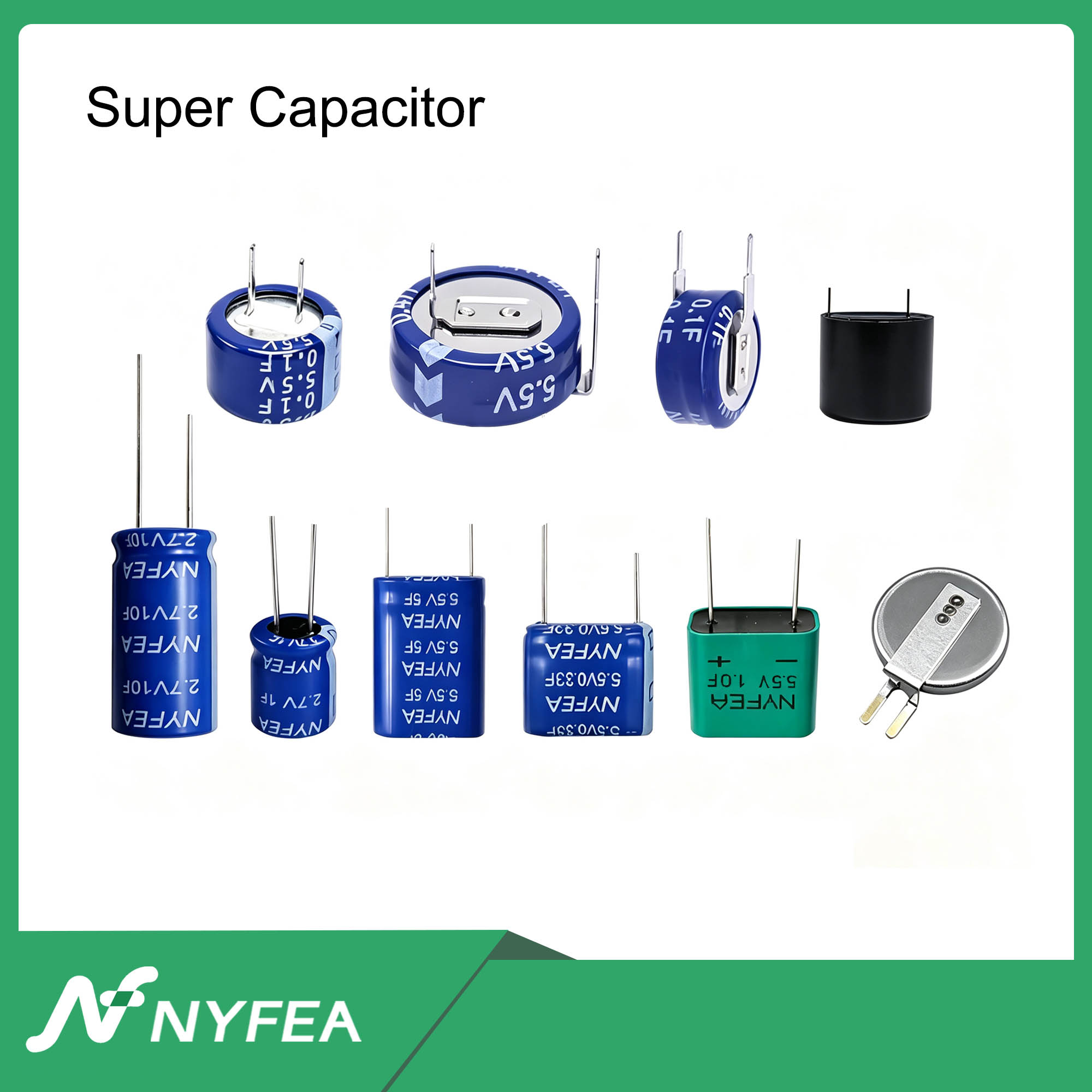
Supercapacitors, also known as ultracapacitors and sometimes referred to in the market as farad capacitors, are high-capacitance electrochemical energy-storage devices. They store energy primarily through charge separation at the electrode–electrolyte interface. Compared with conventional capacitors, supercapacitors generally provide greater energy-storage capacity. Compared with rechargeable batteries, they typically offer faster charge and discharge response, longer cycle life, and better power-delivery characteristics. They are suitable for backup power, power-loss hold-up, transient power support, and energy-buffering applications.
The supercapacitor product range consists of the NR, NB, NM, and other series. The NR Series primarily uses a wound construction, while the NB Series mainly consists of coin-type devices. The NM Series includes products in sealed and combination configurations. Each series offers a selection of capacitance values, rated voltages, dimensions, terminal configurations, and operating temperature ranges. NR, NB, and NM are product series codes. Specific electrical characteristics cannot be determined solely from these codes and must be confirmed in the datasheet for the applicable model.
The NR wound supercapacitor range primarily includes the NR2R7 and NR3R0 Series. According to the currently available datasheets, the NR2R7 Series has a rated voltage of 2.7 V and nominal capacitance values ranging from approximately 0.3 F to 25 F. The NR3R0 Series has a rated voltage of 3.0 V and nominal capacitance values ranging from approximately 3.3 F to 150 F. Individual models differ in equivalent series resistance (ESR), leakage current, permissible operating current, and dimensions. These devices can be used for pulse-load support, power-supply transient support, and short-duration energy delivery.
The NB coin-type supercapacitor range primarily includes the NB5R5 and NB614 Series. The NB5R5 Series offers nominal capacitance values ranging from approximately 0.1 F to 5 F, with C-type, H-type, V-type, and other terminal configurations. Certain models are designed for high-temperature operation. According to the currently available NB5R5 datasheets, some products have a rated operating voltage of 5.0 V and a surge voltage of 5.5 V. The “5R5” designation in the model number must therefore not be interpreted as indicating a continuous operating voltage of 5.5 V.
The NB614 Series includes low-profile, board-mount products with a rated operating voltage of 3.3 V. NB Series devices are suitable for backup power and power-loss data retention in real-time clocks, memory devices, smart meters, and low-power electronic equipment.
The NM5R5 Series includes supercapacitors in sealed and combination configurations. According to the currently available product information, sealed products offer nominal capacitance values ranging from approximately 0.22 F to 1.5 F, while products in combination configurations range from approximately 0.1 F to 5 F. Certain models have a rated voltage of 5.5 V. The series is available in a range of dimensions and lead configurations, making it suitable for electronic systems with specific requirements for operating voltage, hold-up time, or mounting configuration.
The usable energy and output capability of a supercapacitor are affected by nominal capacitance, discharge cutoff voltage, ESR, leakage current, load current, and operating temperature. ESR causes an instantaneous voltage drop and power loss, while leakage current affects long-duration hold-up performance. Actual backup time therefore cannot be estimated from nominal capacitance alone. Device selection should also take into account capacitance tolerance, rated operating voltage, surge voltage, permissible charge and discharge current, expected service life, dimensions, and mounting method.
Supercapacitors are generally polarized and must be protected against reverse polarity, continuous overvoltage, overcurrent, and operation outside the specified temperature range. When multiple cells are connected in series, voltage imbalance among individual cells caused by parameter variations must also be evaluated. Appropriate voltage-balancing measures should be implemented according to system requirements.
The parameter ranges presented here provide an overview of the currently available product portfolio and do not indicate that every model supports all listed characteristics. Refer to the official datasheet for the applicable model for detailed specifications, test conditions, and application requirements.

RFID Reader Chip
Real-Time Clock Chip
Temperature Humidity Sensor