HIGH-HUMIDITY SENSOR QUALIFICATION
SHT30 Humidity Drift Above 80% RH: Condensation, Recovery and FHT30 Qualification
A reading that shifts after prolonged high humidity is not automatically a failed sensor. The useful question is whether the cause is reversible moisture uptake, actual condensation, contamination, a temperature gradient—or a combination of them.
Direct answer
80%RH is not an instant failure threshold for the SHT30. Sensirion specifies 20–80%RH as the recommended normal humidity range and says long exposure outside that range, especially at high humidity, can temporarily offset the RH output. Its SHT3x-DIS datasheet gives an example of approximately +3%RH after 60 hours above 80%RH, followed by gradual self-recovery after return to normal conditions.
Source: Sensirion SHT3x-DIS datasheet, Version 7, December 2022. The +3%RH example is an exposure example, not a guaranteed shift for every unit.
Condensation is a separate event. If a sensor surface falls below the local dew point, liquid water can form and the reading can saturate or become unrepresentative until the assembly dries.
What changed in this review
As of September 18, 2026: this article now separates non-condensing high-RH exposure, condensation challenge and recovery evidence, and maps each condition to an FHT30 qualification decision.
- Added a three-layer evidence model for exposure, recovery and the finished product.
- Added a visible FHT30 comparison and an FAQ covering the main qualification questions.
- Retained the cited SHT3x-DIS figures and marked FHT30 as a candidate for evaluation.
What does “SHT30 drift above 80% RH” mean?
Engineers often use drift for any result that differs from a reference. That shorthand hides several mechanisms. Calibration error is the equilibrium difference between a device and a traceable reference. Hysteresis depends on whether the sensor arrived from a dry or humid condition. Long-term drift develops over months or years. Prolonged high humidity can add a temporary offset as the sensing polymer retains a memory of recent conditions.
Condensation, contamination and test temperature error are different again. A temporary high-RH offset may fade after the device returns to its normal range. A thermal-gradient error disappears when the fixture reaches equilibrium. Liquid water requires dry-out and inspection of the full assembly. Contamination from cleaners, adhesives or outgassing plastics may recover only partly—or not at all.
Published SHT30-DIS baseline: typical RH accuracy ±2%RH, hysteresis ±0.8%RH at 25°C, specified RH range 0–100%RH and typical long-term drift below 0.25%RH/year in the stated normal operating range.
Why 80% RH is a qualification boundary, not a cliff
The SHT3x-DIS datasheet example—about +3%RH after 60 hours above 80%RH—identifies direction, scale and exposure time. It is not a guaranteed shift for every unit or environment. Actual behavior depends on RH level, temperature, dwell time, prior history, airflow, contamination and lot variation. A brief excursion to 82%RH is not equivalent to days near saturation.
It is also easy to mistake test error for sensor offset. Relative humidity is strongly temperature dependent. Sensirion's testing guidance says the reference and device under test must be at the same absolute temperature. Heat from the PCB, cables, chamber fan or nearby electronics can keep one sensor warmer than another and create an apparent RH disagreement.
High humidity and condensation require different tests
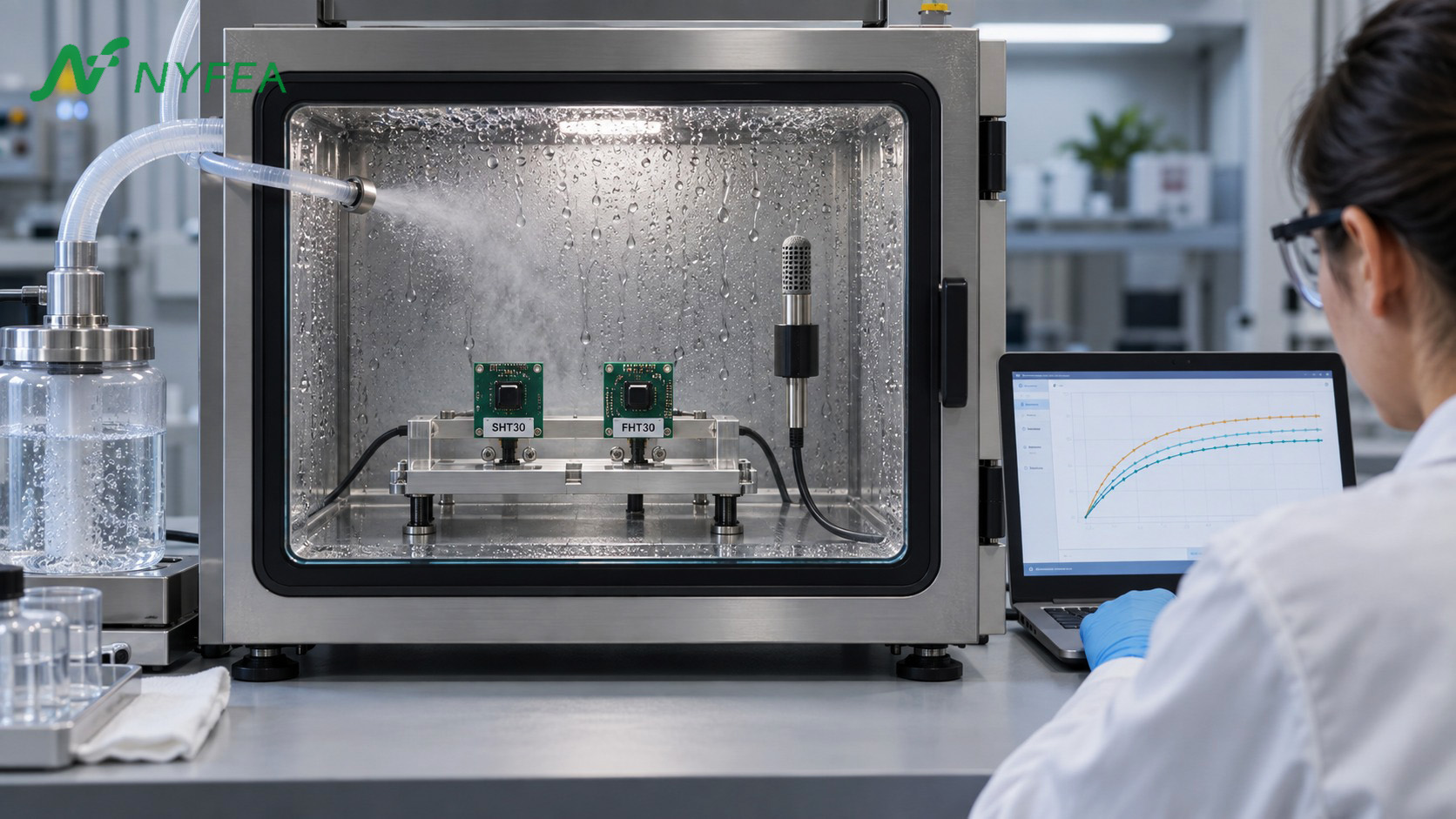
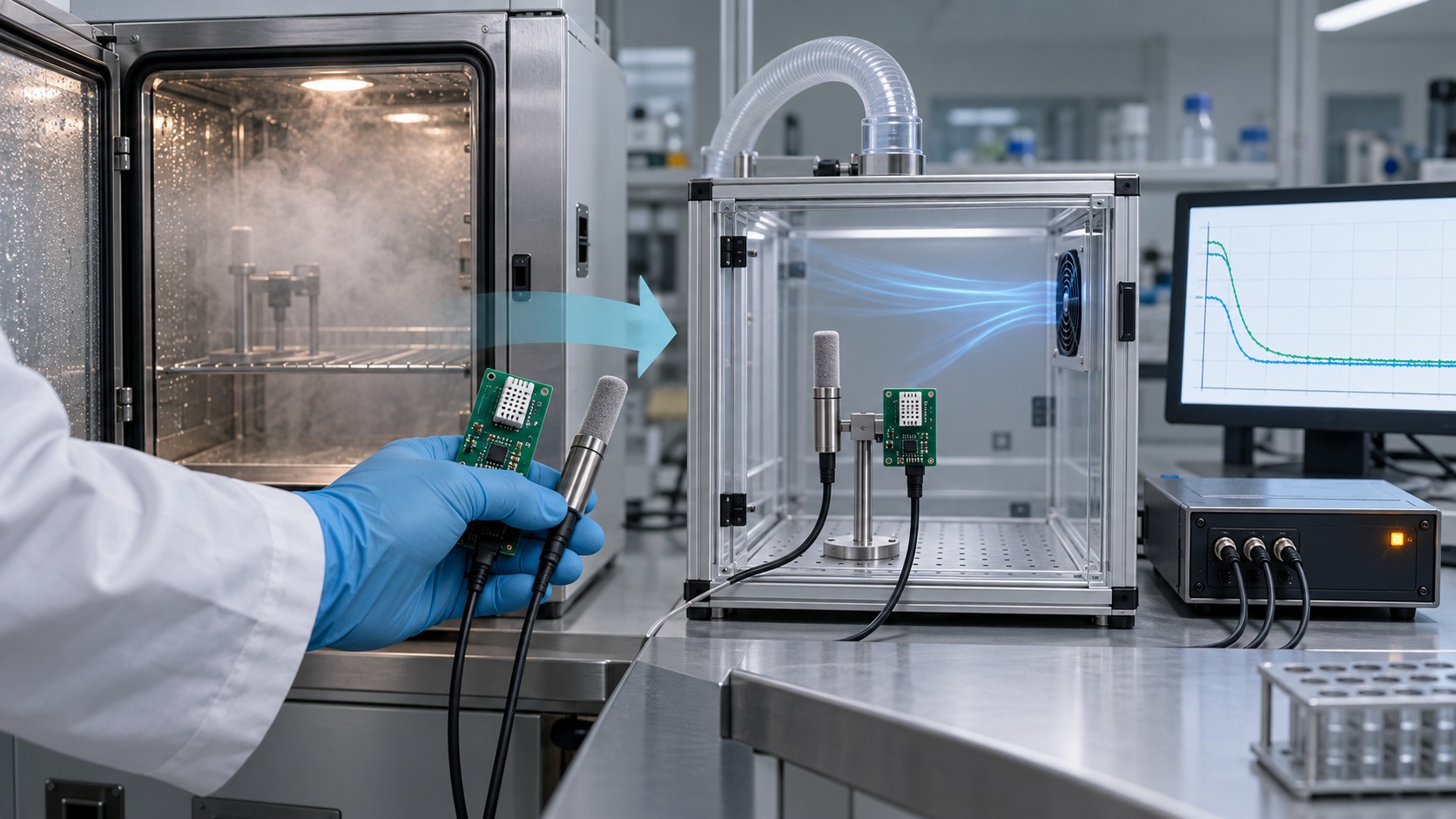
Air at 90%RH can still be free of liquid water. Condensation begins when the sensor or nearby surface drops below the local dew-point temperature. It can occur during cold start, defrost, rapid temperature ramps, outdoor night cooling or movement from an air-conditioned room into humid air.
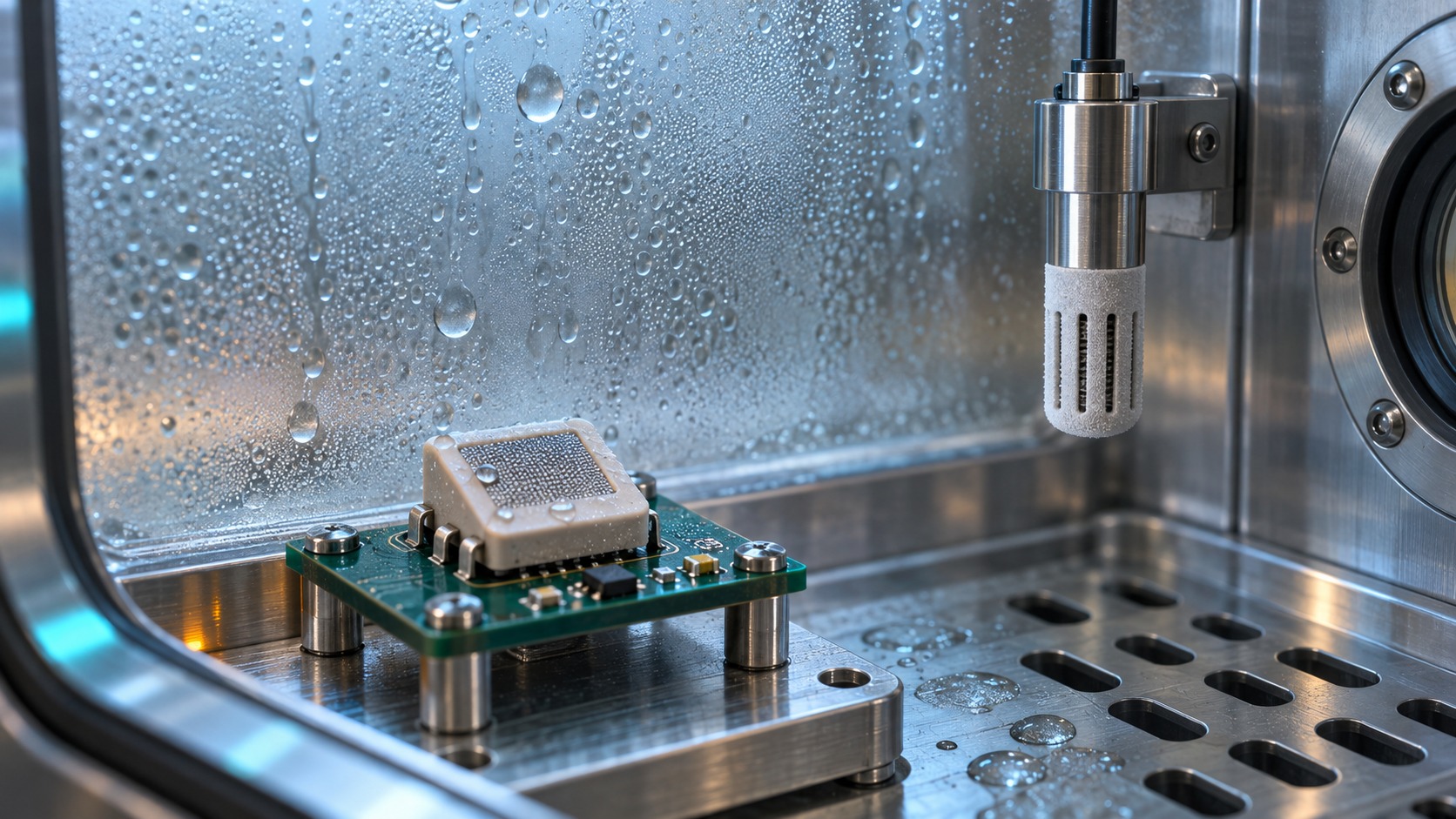
Once droplets form, an RH value near 100% is no longer a complete description. Water can bridge conductors, trap residues, promote corrosion, block a sensing opening or cause a long dry-out. A chamber wall covered with droplets does not prove that the sensor is wet, and a saturated RH reading does not prove it either. Record surface temperature, calculated dew point and visible wetting separately.
Test rule: keep a non-condensing high-RH dwell separate from a deliberate condensation challenge. The two stresses need different pass criteria.
How should an SHT30 high-humidity drift test be diagnosed?
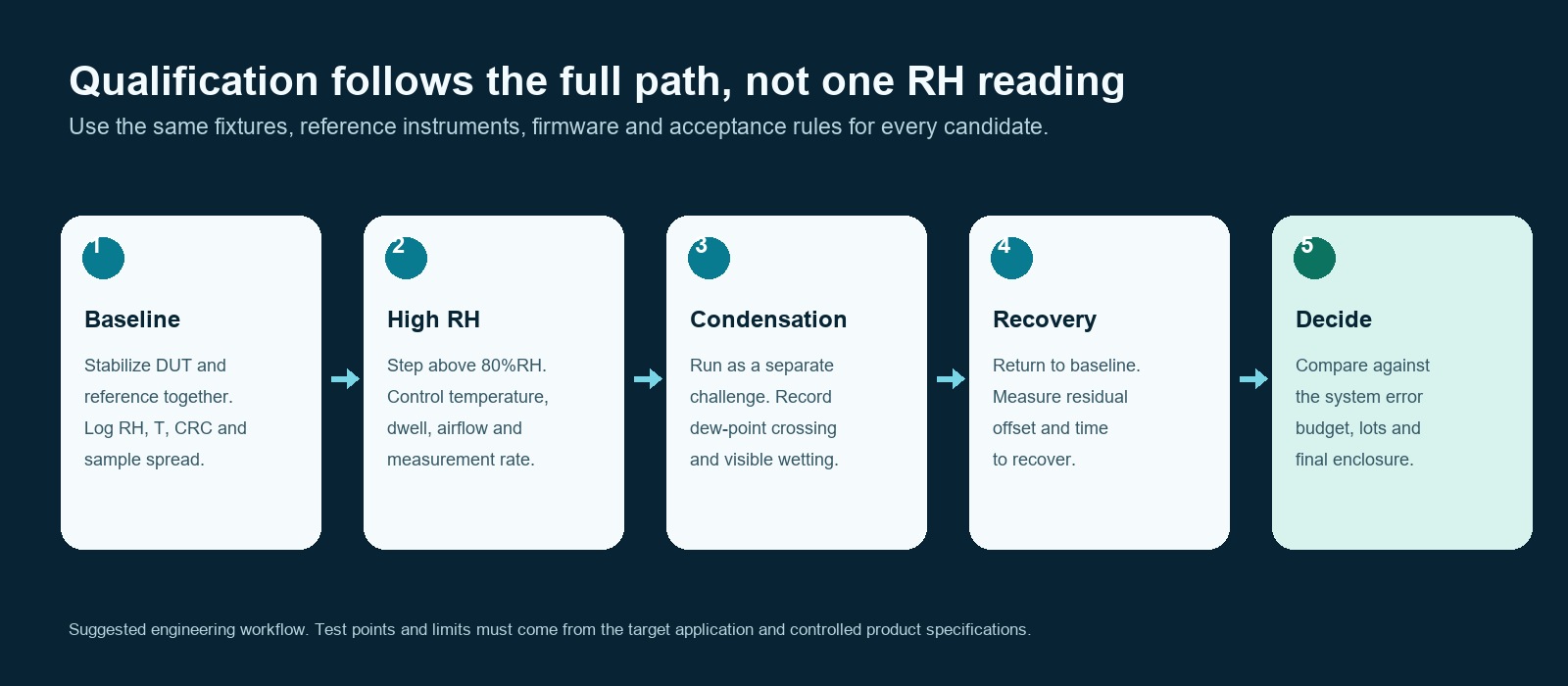
- Establish a controlled baseline. Stabilize the DUT and a calibrated reference together at a moderate condition. Record signed error across several devices and lots.
- Control temperature before judging RH. Place the reference close to the DUT, minimize gradients and log both temperature channels alongside RH.
- Preserve the exposure history. Record ramp rate, dwell, RH, temperature, airflow, measurement cadence and heater activity.
- Watch the digital path. Log raw words, CRC failures, bus errors, resets and status flags.
- Return to baseline and keep logging. A reversible offset should trend toward its initial value. Persistent error points to contamination, damage, corrosion, reference trouble or a thermal effect.
- Inspect materials and process history. Board wash, solvent vapor, uncured adhesive, coating and packaging outgassing can affect polymer humidity sensors.
What recovery procedure applies to SHT30?
Sensirion describes passive recovery after an SHT30 returns to its normal temperature and humidity range. For severe exposure, its June 2025 SHTxx handling instructions suggest an accelerated reconditioning sequence: bake at 100–105°C and below 5%RH for 10 hours, then rehydrate at 20–30°C and about 75%RH for 12 hours.
That is a Sensirion SHTxx procedure. It is not automatically safe for a populated assembly, battery, connector, adhesive, display or enclosure, and it must not be copied to FHT30 without NYFEA's controlled instruction. Save the as-exposed and passively recovered data before any accelerated treatment.
Both devices publish an integrated heater function. Heater operation changes the local sensor temperature and therefore the reported RH. It does not replace enclosure drainage, vent design, contamination control or a defined recovery protocol.
FROM SHT30 HIGH-HUMIDITY EVIDENCE TO FHT30 QUALIFICATION
Why FHT30 belongs in this SHT30 discussion
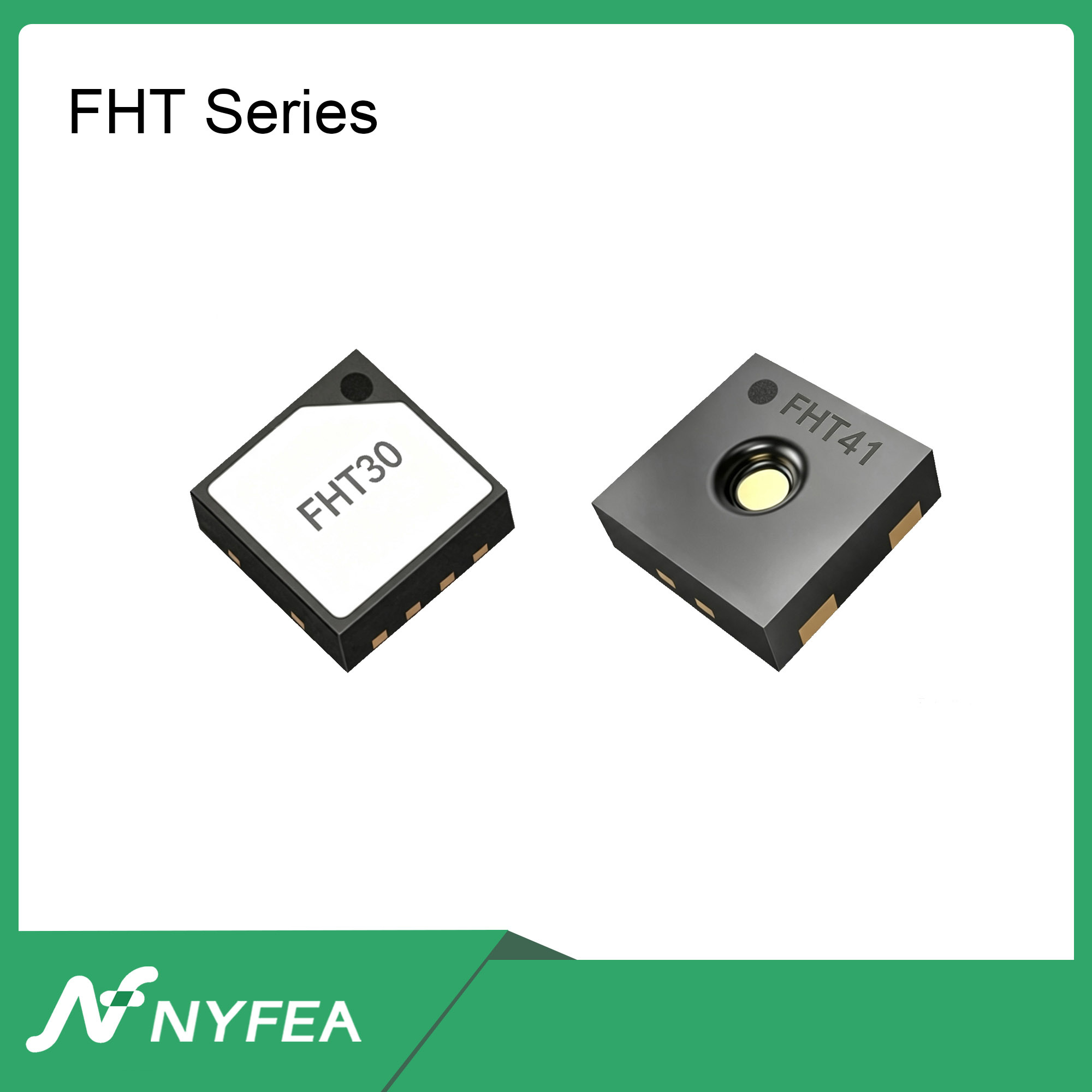
FHT30 is a digital temperature and humidity sensor candidate for an SHT30-class design. Published package, supply, I²C and measurement features can start a controlled comparison; they do not establish equal high-humidity behavior or a drop-in replacement.
- What starts the review
- Documented
0x44/0x45addressing, I²C operation and CRC-protected measurement data allow an engineering comparison to begin. - What can be reused
- The SHT30 baseline, chamber profile, reference probe, firmware logs and finished-product error budget form the FHT30 evaluation reference.
- What still needs proof
- High-RH offset, condensation tolerance, recovery, command timing, final-enclosure response and production-process effects need target-product evidence.
Where FHT30 fits
NYFEA FHT30 is a candidate for evaluation in SHT30-class digital humidity-sensor designs. Its published page lists a 2.5 mm × 2.5 mm DFN-8 package, 2.0–5.5 V supply, I²C operation up to 1 MHz, selectable 0x44 and 0x45 addresses, CRC-protected measurement words, an integrated heater, a 0–100%RH range and typical accuracy of ±3%RH.
Those similarities define a shortlist. They do not establish pin compatibility, command compatibility, timing equivalence, equal accuracy, identical high-humidity behavior or equal production qualification.
Choose FHT30 for evaluation when the design team can repeat the SHT30 baseline and revalidate command timing, error budget, enclosure behavior and production conditions. If those conditions cannot be controlled, the published feature match is not enough to support a replacement decision.
| Published item | SHT30-DIS | FHT30 | Engineering consequence |
|---|---|---|---|
| Typical RH accuracy | ±2%RH | ±3%RH | Rebuild the system error budget. |
| RH range | 0–100%RH | 0–100%RH | Range does not establish condensation behavior. |
| Supply | 2.15–5.5 V | 2.0–5.5 V | Verify rail, ramp and brownout behavior. |
| I²C address | 0x44 / 0x45 | 0x44 / 0x45 | A matching address proves only address selection. |
| High-humidity evidence | Manufacturer guidance published | Application evidence required | Run the same exposure and recovery sequence. |
A practical FHT30 high-humidity qualification plan
This is an engineering template, not a manufacturer specification. Set pass limits from the application error budget before testing and use enough samples and lots to expose variation.
- Baseline: measure signed RH and temperature error, noise, CRC rate and reset behavior on the production PCB.
- Non-condensing high RH: step above 80%RH while keeping every surface above dew point; include the real worst-case dwell.
- Humidity cycling: cycle between moderate and high RH to quantify hysteresis and accumulated offset.
- Condensation challenge: if the product can cross dew point, define the wetting mechanism and monitor faults, recovery and corrosion risk separately.
- Passive recovery: return to baseline and log recovery time, residual offset and samples that fail to converge.
- Final-product confirmation: repeat the worst case with the production vent, membrane, coating, adhesive and nearby heat sources.
Release decision
Approve FHT30 only when its controlled specification, firmware behavior, high-RH exposure, optional condensation challenge, recovery data and final-enclosure results all meet predeclared limits. A familiar package or address is not enough.
Use the exact SHT30 order code, a controlled humidity profile and the finished assembly as the baseline. The useful result is not simply “works” or “fails”; it is a retained record of the condition, mechanism, recovery path and release evidence.
FAQ
How do you distinguish an SHT30 failure from a temporary high-humidity shift?
An SHT30 is more likely temporarily shifted when the RH error trends back toward baseline after the device returns to normal conditions. A persistent error, visible wetting, contamination, corrosion, temperature gradient, CRC fault or communication failure requires a separate failure investigation.
Does operating above 80%RH mean an SHT30 has failed?
No. Sensirion lists 20–80%RH as the recommended normal range and gives a temporary RH-offset example after prolonged exposure above 80%RH. Separate an offset that recovers from contamination, condensation, a temperature gradient or a communication fault.
Does a 100%RH reading prove that the sensor is covered by water?
No. A high RH reading alone does not prove liquid water is on the sensing element. Confirm condensation with the local dew point, surface temperature and visual inspection, then assess the complete assembly.
Which conditions can make an SHT30 drift or fail?
Common causes include prolonged high humidity, condensation, chemical contamination, board or enclosure temperature gradients, corrosion, assembly materials and digital communication faults. Separate these mechanisms with a controlled baseline, exposure record and recovery log.
Can I use the SHTxx bake and rehydration procedure for FHT30?
Do not assume so. The cited bake and rehydration procedure is Sensirion guidance for SHTxx devices. Ask NYFEA for the controlled FHT30 instruction and confirm that the assembled product can tolerate any proposed treatment.
What should be logged during a high-humidity qualification test?
Log the RH and temperature reference, DUT readings, ramp and dwell conditions, airflow, measurement rate, CRC and bus errors, resets, heater state, sample identity and the recovery trend after return to baseline.
Is FHT30 a guaranteed drop-in replacement for every SHT30 design?
No. Similar package, I²C address or headline specifications do not establish pin, command, timing, firmware, accuracy or final-enclosure equivalence. Release only after controlled design-specific validation.
When is a final-enclosure test necessary?
Always when the product enclosure, vent, membrane, coating, adhesive, cable heat, nearby electronics or likely dew-point crossing can change the sensor environment. The final product is the release target, not an open evaluation board.
How long should an SHT30 recover after high-humidity exposure?
There is no single recovery time for every SHT30 exposure. Record the passive recovery trend after the device returns to its normal temperature and humidity range, then define the application limit from residual offset and time to converge.
Can a membrane or conformal coating change the RH reading?
Yes. A membrane, coating, adhesive, vent or enclosure can change diffusion, airflow, contamination exposure and local temperature. Qualify the complete assembled product and compare open-board and final-enclosure response before applying a firmware offset.
Evaluate FHT30 against your real humidity profile
Review the published FHT30 engineering baseline, then request the current controlled specification, samples and application support for your enclosure and firmware.
Sources and evidence
- Sensirion, SHT3x-DIS Datasheet, Version 7, December 2022.
- Sensirion, Handling Instructions for SHTxx Sensors, Version 9, June 2025.
- Sensirion, Testing at Ambient Conditions, Version 3, October 2022.
- Sensirion SHT30-DIS-B product page.
- NYFEA FHT30 engineering product page.
Independence notice: Sensirion and SHT30 are referenced only to identify the third-party product discussed. All third-party names and marks belong to their respective owners. NYFEA is not affiliated with, sponsored by or endorsed by Sensirion. Confirm current controlled documents before design release.